The Words Behind the Place

Our story, our promise, and what we are committing to.

CommonGround is a proposed year-round destination in Ontario where local food, farming, nature, craftsmanship and everyday community life share one piece of ground. This page holds the words behind it — the promise we intend to keep, the beliefs we work from, and the commitments we would like to be held to.

Stage: Vision & Foundational Intent Read the Messaging Guide →
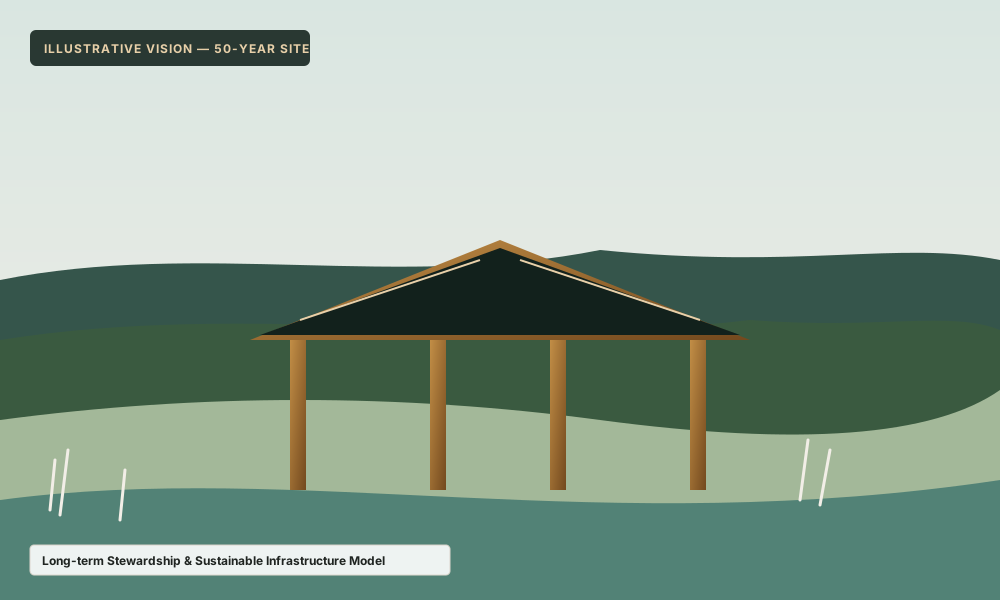
Conceptual rendering of the envisioned CommonGround landscape with orchard rows, walking paths and timber gathering structures Expand Rendering
Brand Promise

Our promise

CommonGround will be a place that feels like it has always been here — easy on a first visit, familiar on a fiftieth, and steady enough that families, farmers and local businesses can build something lasting on it.

A promise is only worth writing down if it can be checked. Ours asks four things of us, in every season and every decision, from the shape of a footpath to the wording of a vendor agreement.

Welcoming, without exception

You should not need a reason, a reservation or a budget to come here. A grandparent with a walker, a toddler on a first walk, a teenager with nowhere else to be and a farmer with an hour to spare should all find somewhere that fits them.

Beautiful in every season

Beauty is not decoration added at the end. It is the reason people return in November as readily as in July, and it is the first thing we protect when a budget tightens.

Fair to the people who make it work

Growers, makers, staff and neighbours carry this place. Their terms should be plain, their share should be honest, and their success should be the measure of ours.

Honest about where we are

We label what is a vision, what is proposed and what is settled. No one should ever learn from someone else that a plan was not as far along as it sounded.

Our Story

It began as a question, not a plan.

Why does a region this good at growing food have so few places to gather around it?

The question came from ordinary noticing. Fields here produce food that people travel to eat somewhere else. Markets fill a parking lot for a few warm months and then go quiet for the rest of the year. Families run out of places to spend a Saturday together that do not ask them to buy something they will have forgotten by dinner. And land that could hold something worth keeping tends to be covered by whatever gets approved first.

Underneath all of it was the same gap: plenty of places to buy things, not many places to belong. So the question sharpened. What would it take to build one place that stayed open through the year, paid its own way, treated the people selling there as partners rather than tenants, and still belonged to the community using it?

CommonGround is our answer to that question — and we are in the part of the work where answers are tested rather than announced. That means talking to residents, farmers, vendors, landowners, municipalities and community organizations before land, financing or approvals are committed to. It means a small public market held first, to learn what people actually want. It means being willing to hear that part of the idea is wrong.

We would rather build one place properly than several places quickly. That single decision shapes everything else on this page.

Where we are today Concept development, validation and partnership building. Nothing here describes secured land, financing, zoning, approvals, vendors, sponsors or opening dates. See the current project status →

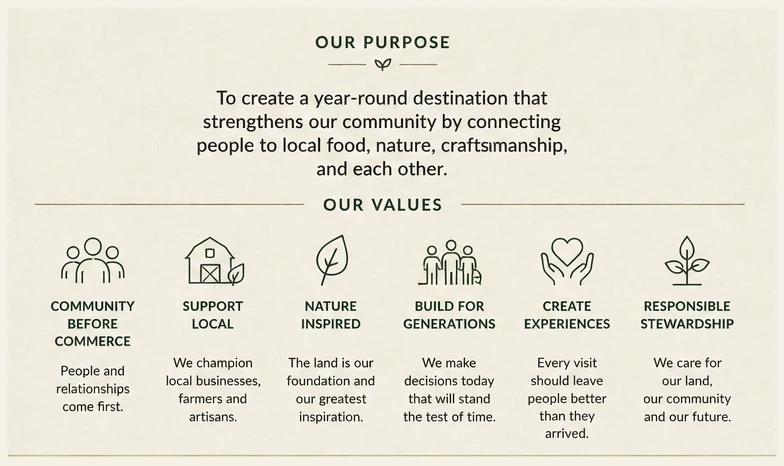
CommonGround purpose and values visual board

Purpose & Values Board

The founding purpose and community commitments, in one view.

Our Mission

What we are here to do

To create one professionally managed place where entrepreneurs, farmers, artisans, families, landowners, municipalities and partners all benefit from the same success.

Shared success is the whole design. A destination that only works for whoever collects the rent is a building. A destination that works for the grower, the maker, the family, the neighbour and the municipality at the same time becomes part of a region's life — and that is the harder, more durable thing to build.

Shared success

Every arrangement here should be one both sides would sign again. When a vendor has a strong season, so does the site; when the site improves, so do the vendors on it.

Thoughtful design

One cohesive place rather than a collection of separate attractions. Paths, buildings, gardens, water and gathering spaces are planned together, so a visit feels like one experience.

Long-term stewardship

Soil, trees, water and buildings are treated as things we are holding for the next generation. Decisions are tested against how they will look in fifty years, not in one.

Our Vision

Where this is going

One exceptional flagship destination in Ontario — well built, well loved and standing on its own — before a second is ever considered.

In that place, nature is the main attraction. Not a backdrop, not landscaping around a parking lot: the trees, water, orchards, gardens, meadows and open ground are the reason to come. Everything built here — pavilions, market halls, trails, terraces, gathering spaces — exists to make that landscape easier to enjoy and to keep.

We picture a Tuesday in October as clearly as a Saturday in July: someone buying bread on the way home, a class walking the orchard rows, two neighbours sitting in the same spot they always sit in, a maker unlocking a permanent door that started out as a weekend stall. The measure of the vision is not opening day. It is the ordinary weeks, twenty years in, when the place is simply part of how the region lives.

Explore the Full Vision & Brand System
Our Values

Eight beliefs we hold to when a decision is difficult.

These are not aspirations posted on a wall. They are the tie-breakers we use when time, money and ambition pull in different directions.

01

Community before commerce

Commerce keeps this place alive; it is not the reason it exists. Every way of earning here has to make the day better for the people visiting, or it does not belong.

02

Beauty is infrastructure

Good materials, mature trees, honest craftsmanship and well-made paths are working parts of the site. They are what brings people back, so they are budgeted like plumbing, not like decoration.

03

Build for generations

We plan for the people who will inherit this place, not for the fastest return. If a choice looks clever this year and poor in twenty, it is a poor choice.

04

Partnerships before purchases

A neighbour with shared interest is worth more than a signed invoice. We would rather build something with someone than buy our way around them.

05

Cash is the last tool

Before money is spent, we look for the partnership, the trade, the shared asset or the simpler solution. Spending is what we do when nothing better is available — not first.

06

Quality is never sacrificed for speed

An opening date is not worth a corner cut. Anything that will be walked on, sat on or relied upon for decades gets the time it needs.

07

Construction-level discipline

A welcoming place is the result of unglamorous rigour: schedules, budgets, maintenance plans, safety reviews and honest reporting. Warmth out front, construction-level discipline behind it.

08

Every improvement strengthens the visit

New buildings, features and programs must make the whole site better, not simply add to it. If an addition does not earn its place in a guest's day, it waits.

Why CommonGround Exists

Why this, and why here

Because a region can be full of good food, good work and good people, and still have nowhere for them to meet.

CommonGround exists to close three gaps at once. Each of them is survivable on its own. Together, they quietly cost a region its gathering places.

The seasonal gap

Local food and outdoor gathering all but disappear for half the year. A place designed for four seasons keeps the habit, the income and the community rhythm going through the cold months.

The belonging gap

Most public space now asks for a purchase or a booking. Families, seniors and young people need somewhere they can simply be — comfortable, safe and free to walk into.

The starting gap

A grower, baker or maker with a good product often faces a first step that is far too large: a lease, a build-out, a full week of staffing. A smaller, well-run first step keeps good businesses from stopping before they begin.

Closing those gaps is worth doing properly. That is why the work starts with listening rather than building, and why the first thing we intend to hold in public is a market small enough to learn from.

Share Your Input See the Validation Market
What Makes CommonGround Different

Not a market, a mall, a venue or a food-truck park.

CommonGround borrows something from each of them and is none of them. Six differences explain most of it.

Nature is the attraction

Elsewhere, the landscape is what surrounds the building. Here, the orchard, the water, the trees and the open ground are the reason to come, and the buildings are arranged to serve them.

One place, not a collection of tenants

Signage, materials, planting, lighting and paths are designed together so a visit reads as a single place. Nobody has to compete for attention with a louder neighbour.

Built for all four seasons

Shelter, heat, indoor space, winter programming and year-round operations are part of the plan from the start, not an afterthought once the tents come down.

Vendors are meant to grow, not just rent

The intent is a real path: a first weekend stall, then a regular spot, then a permanent space, with shared infrastructure that a single small business could not justify alone.

Professionally managed

Maintenance, safety, cleanliness, scheduling and guest experience are somebody's actual job. Goodwill and volunteers are precious; they are not a maintenance plan.

We say what is not settled

Each part of this project is labelled — Vision, Proposed, Under Assessment, In Development, Validation Stage or Confirmed — so partners and neighbours can judge it accurately.

Our Commitments

Five commitments we would like to be held to.

These are written as commitments of intent while the project is in validation. Where something depends on land, approvals or partners, it says so.

Commitment 01

Our commitment to local businesses

If your business grows here, we have done our job. If it outgrows us, we have done it well.

  • Terms written in plain language, with no clause that only makes sense to the side that wrote it.
  • A real path from a weekend stall to a regular spot to a permanent space, so growing does not mean leaving.
  • Shared infrastructure — power, water, cold storage, washrooms, waste, security, parking — so a small business is not solving all of it alone.
  • Marketing that names the maker, not only the market.
  • A balanced mix rather than a full one: enough variety that customers keep coming, enough room that nobody is crowded out.
  • Rent structures designed to survive a slow season, because a vendor who closes in March helps no one.

Status: Vendor categories, fees and space types are being designed with the businesses they will affect. No space is offered, reserved or priced yet. Vendor pathway →

Commitment 02

Our commitment to families

A day here should cost a family very little and give them something they still talk about at dinner.

  • Free to walk in. Paying is for what you choose to carry home.
  • Shade, seating, clean washrooms, drinking water and change tables treated as infrastructure, not as extras.
  • Play made of land, water, timber and open space — the kind children invent their own games in.
  • Room for every generation at once: grandparents seated within sight of the play area, teenagers with somewhere that feels like theirs.
  • Traditions worth repeating — the same weekend, the same walk, the same first apple of the season, year after year.
  • Level paths, quiet corners and clear wayfinding, so a visit works for strollers, walkers, wheelchairs and anyone who needs a calmer route.

Status: Family features and seasonal programming are proposed and shaped by community input. Tell us what your family would use →

Commitment 03

Our commitment to agriculture

Farming is not our theme. It is our neighbour, our supplier and much of the reason to be here.

  • Direct sales that return a fair share to the person who grew, raised or made the thing being sold.
  • Working ground on site — orchards, gardens, greenhouses — planted to produce, not to decorate.
  • A first step small enough for new and small-scale producers to test a product without risking a season's savings.
  • The work explained honestly: weather, timing, cost and labour, without turning farming into scenery.
  • Soil, water and pollinators managed as fifty-year assets, with practices chosen for the land's long health.
  • Local producers approached as partners in how the site operates, not as a category to be filled.

Status: Under assessment. No supply arrangements, grower agreements or agricultural programs are in place. Producer pathways →

Commitment 04

Our commitment to nature

The land was here first and will be here after. Anything we build has to earn its place on it.

  • Mature trees, water, wetland and habitat identified and protected first; buildings placed around what stays.
  • Native planting, pollinator habitat and hedgerows chosen for the region rather than for a catalogue.
  • Stormwater, noise and light designed to be gentle — including lighting that leaves the night sky visible.
  • Natural, durable materials — heavy timber, fieldstone, cedar, forged metal — that age well instead of wearing out.
  • Growth in layers, so each stage is absorbed by the land and settled in before the next begins.
  • Stewardship measured and reported, in the same plain terms as everything else we publish.

Status: Vision and intent. Site-specific environmental review, conservation authority input and municipal approvals would be required before any work. The envisioned experience →

Commitment 05

Our commitment to the community

CommonGround only works if the people nearby can point at it and say: that one is ours.

  • Ask before we build, and keep asking after we do.
  • Report progress plainly — including delays, changes of direction and the parts that are not working.
  • Hold space for community groups, schools, service clubs, choirs and local musicians, not only for what sells.
  • Hire locally and work with local trades and suppliers wherever we responsibly can.
  • Route good surplus food to neighbours who need it, as a standing part of operations rather than a seasonal gesture.
  • Explain decisions, not just announce them — especially the unpopular ones.
  • Stay reachable: a real person answering a real inquiry, in a reasonable amount of time.
  • Keep the front door free, so belonging here never depends on what someone can spend.

Status: Community programs and food-security work are in development and depend on partners. Common Good work →

An Invitation

These words are meant to be tested.

If something here rings true, tell us. If something is missing or wrong, tell us that instead — this is the stage where it can still change. The place will be better for having been argued about early.

Share Your Input Start a Conversation Read the Messaging Guide